Reducing Geologic Uncertainty for Subsurface Decisions
Structural geology insights for subsurface modeling in energy, carbon storage, geothermal, and natural resource projects
Nathan Eichelberger, PhD
Founder & Principal Consultant
Expertise in Applying Structural Geologic and Tectonic Concepts to Subsurface Interpretation
Splitrock Geologic Consulting was founded to help clients develop subsurface geologic models that go beyond a static interpretation to provide deep insights into the structural and stratigraphic evolution of their project areas.
Together, we create working geologic hypotheses that address the uncertainties inherent in subsurface interpretations and develop strategies to reduce exploration risk.
I do this by integrating quantitative structural geologic interpretation methods with regional geologic and tectonic frameworks to produce models that reflect both local and regional geologic constraints.
15+ years of applied geoscience experience
PhD in Geosciences, Princeton University
Global project experience across five continents
Extensional, Contractional, and Salt-involved basins
Published researcher under academic and industry projects
Technical expertise in structural geology, seismic interpretation, and subsurface modeling
Working with Clients to Unravel Complex Subsurface Geology
Geologic data regularly presents uncertainties that require multiple working hypotheses. Each interpretation has strengths and weaknesses. We utilize quantitative structural geology techniques to develop new or assess existing interpretations and put them in regional geologic context. Ultimately, this helps clients determine where uncertainties lie, how to address them, and how to factor them into exploration decisions.
-
Interpretation development and evaluation to assess trap presence, reservoir geometry, geologic history, and structural risk.
-
Assistance with geologic assessments for Class VI permits including injection interval characterization, fault system evaluation, and seismic risks.
-
Surface and subsurface structural characterization to define basin architecture and structural frameworks at local and regional scales.
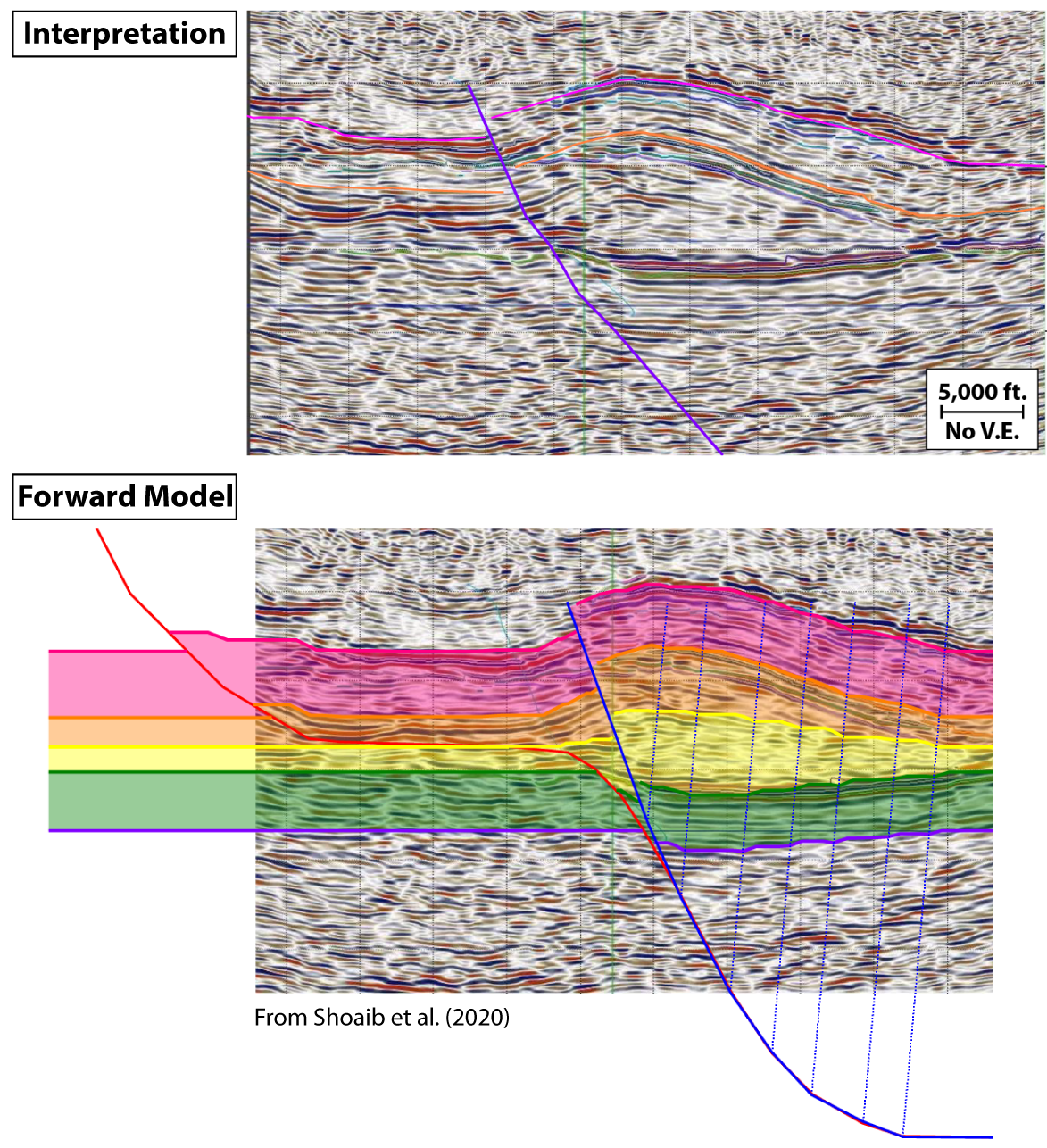
Splitrock Geologic Consulting specializes in rapidly applying quantitative structural geology methods to inform exploration decisions for clients working under tight time lines. Our methods reduce exploration risk in structurally complex settings. We work with clients on generating new interpretations as well as evaluating existing subsurface models (QA/QC).
In addition to subsurface work, we also offer geologic mapping services focused on defining structural architecture at a variety of scales.
Expert Insights, Fast
-
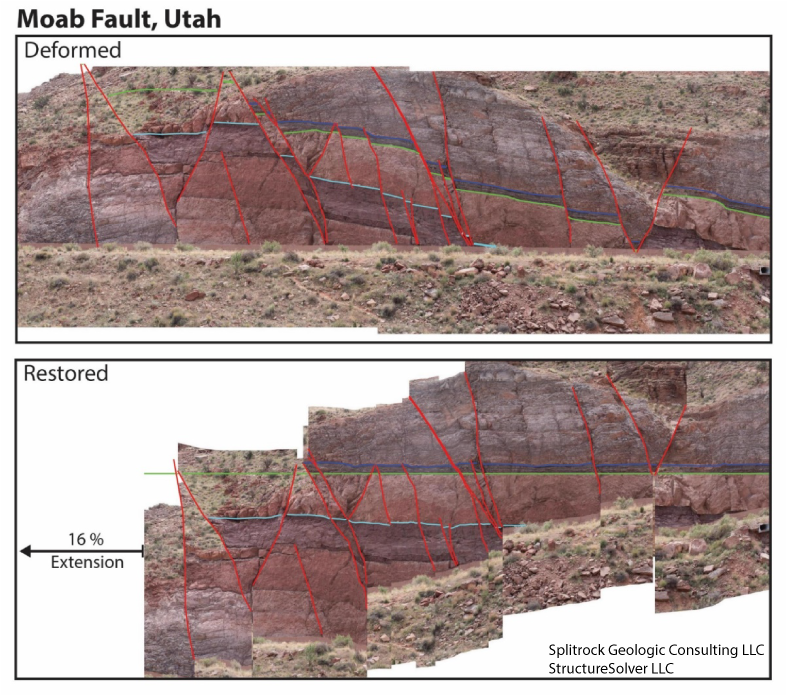
The geologic self-consistency of any subsurface model is quickly revealed by restoring the interpreted faults and folds.
We restore seismic sections and well data along side the interpretation. This reveals the degree to which the interpretation adheres to the underlying data and can provide deeper insights into the geologic history recorded in the data.
-
By quantitatively linking fold geometry to fault geometry, forward models can estimate fault and stratigraphic horizon locations in areas with poor data quality.
In cases where fault-related structures were growing simultaneously with deposition, forward models can be used to extract the timing of structural development.
-
Balanced cross sections apply mass balance concepts to subsurface interpretations. This limits arbitrary interpretation decisions, producing models that are geologically self-consistent and kinematically complete.
Download an example map comparing San Joaquin Basin oil field structures to regional maxmimum horizontal stress here.
-
In cases where subsurface data is limited, geologic maps can still provide significant insights into the subsurface.
Selected Project Experience
Structural Reconstruction
Location: Central Graben, North Sea UK Continental Shelf
Project: Reconstructed multiple interpretation scenarios to evaluate probable reservoir interval distributions and geologic histories. Defined interactions between basement faults, salt migration, and reservoir deposition and erosion.
Structural Stratigraphic Framework Validation
Location: Haltenbanken area, Norwegian Sea
Project: Validated existing interpretation and proposed alternative structural models as part of a fault seal risk assessment in a prospect area adjacent to Njord field.
Carbon Storage Injection Interval Screening
Location: Sacramento Basin, California
Project: Geologic review and assessment of primary and secondary injection intervals for a regional carbon storage center. Assessed structural and seismic hazards and defined reservoir presence, seal, and continuity to de-risk injection well locations.
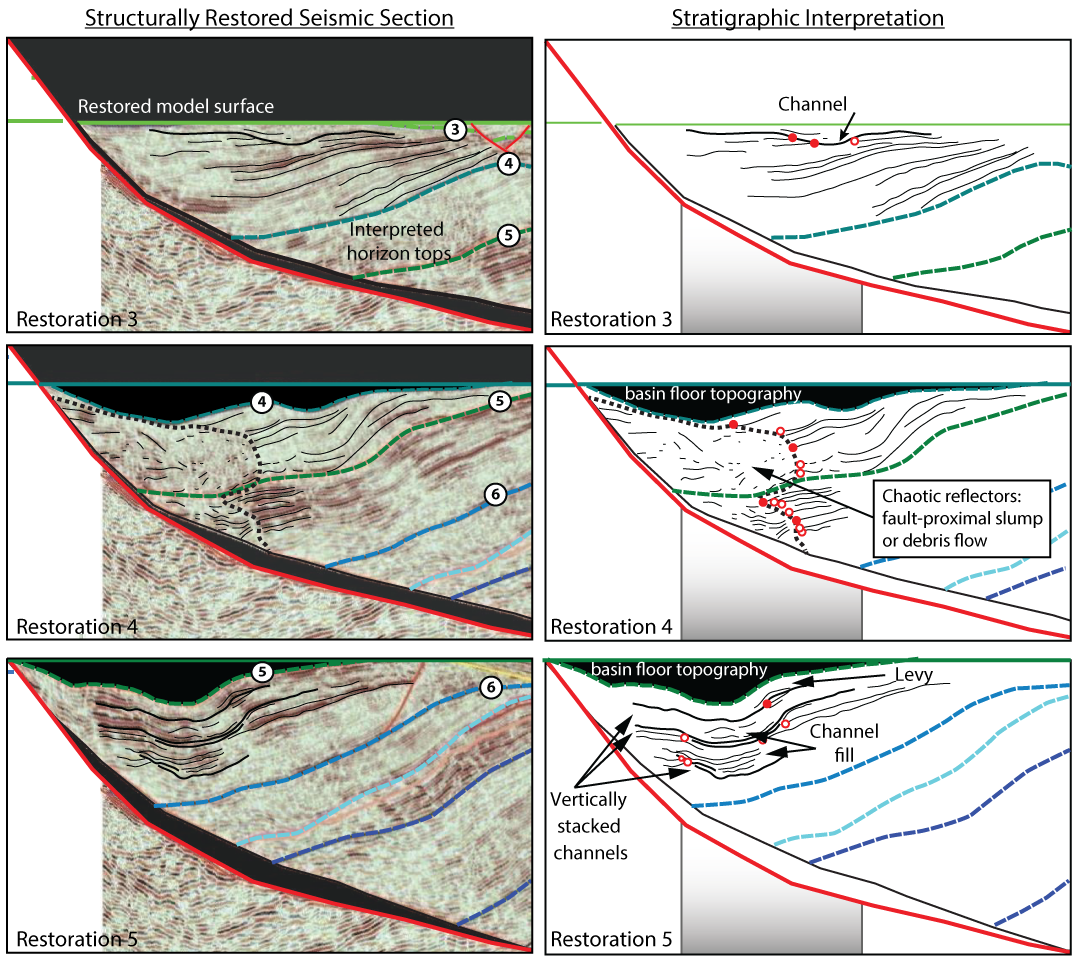
Bohai Bay, China: Restoration of seismic sections based on kinematic forward models of the underlying rift structure. Using the forward modeled horizons to restore the seismic section allowed us to “recover” the pre-deformation stratigraphic architecture of the synrift section. This facilitated the identification of probable channel sands. Similar approaches can be used to identify exploration targets in geothermal or oil and gas applications. Link to publication.
Independent Expertise.
Practical Solutions.
Clients engage Splitrock Geologic Consulting when projects require:
Objective, technical perspectives on complex geologic settings
1
Specialized structural geology expertise
2
Assessments of geologic uncertainties: how they impact subsurface models and exploration decisions
3
Clear communication of complex issues with an emphasis on actionable insights and knowledge transfer
4
Flexible project support on your time line without large-firm overhead
5
Let’s Talk About Your Project
Whether you are evaluating an exploration opportunity, assessing a carbon storage site, or refining a subsurface geologic model, I can help identify critical uncertainties and develop practical solutions.